

Justice Vikram Nath – Landmark Judgments, CJI Tenure
 Copy Link
 Share
Share Save
Save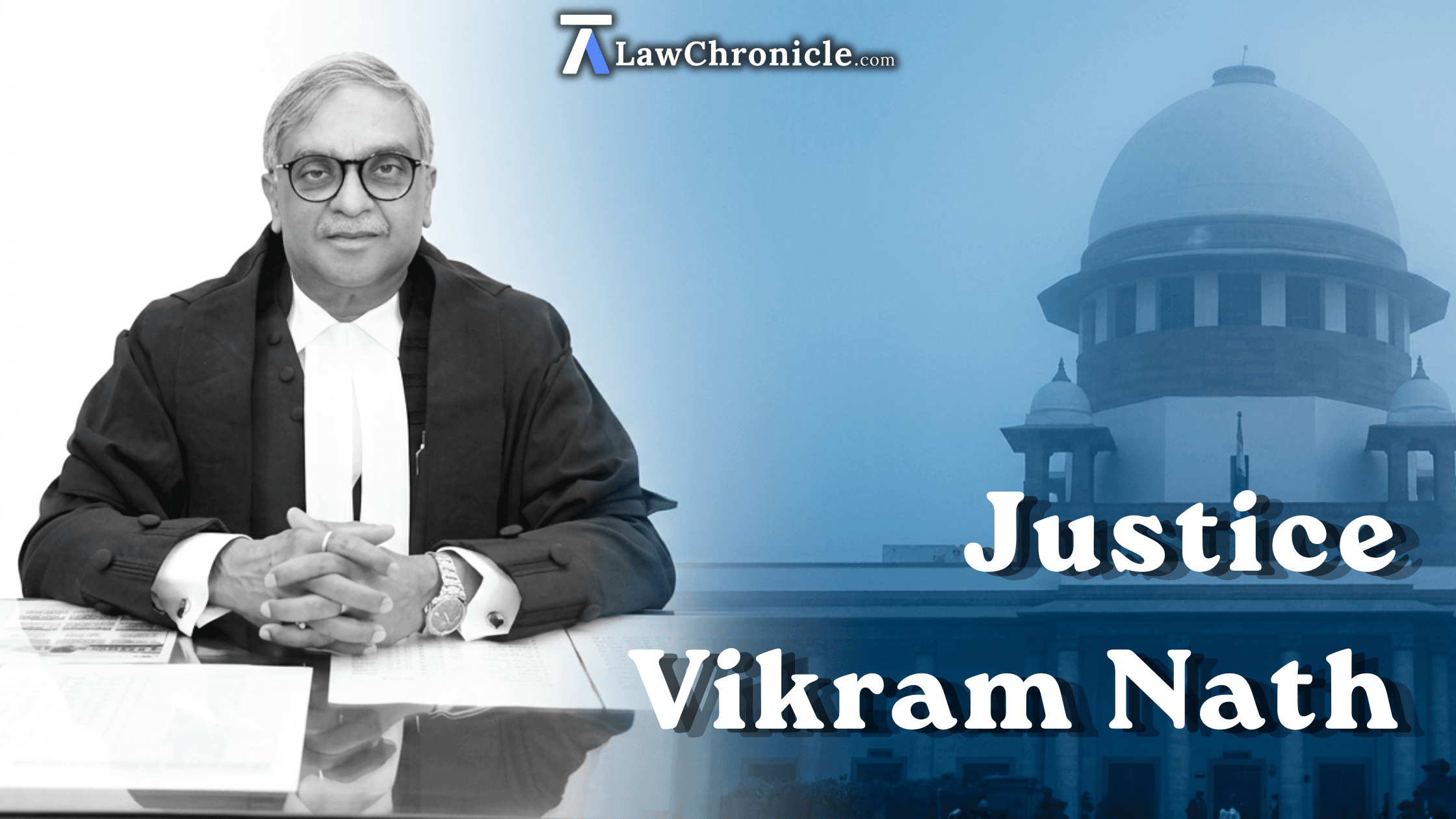
Supreme Court’s Justice Vikram Nath hails from a quiet town in Uttar Pradesh called Kaushambi. Coming from a family of legal professionals for generations, Justice Vikram Nath is one of them, now sitting at the top Court – being a Judge of the Supreme Court of India. He is also set to become the next Chief Justice of India on 9th February, 2027. This article is all about the making of Justice Vikram Nath: A Fourth-Generation Lawyer, a Judicial Innovator, and India's 54th Chief Justice in-line.
Justice Vikram Nath - Career at a Glance
1962: Born in Kaushambi district, Uttar Pradesh
1983: Graduated in Science
1986: LL.B., University of Lucknow
30th March, 1987: Enrolled as advocate, Bar Council of Uttar Pradesh
1987–2004: Practice at the Allahabad High Court
24th September, 2004: Elevated as Additional Judge, Allahabad High Court
27th February, 2006: Oath as Permanent Judge, Allahabad High Court
2014: Transferred to the Karnataka High Court
April 2019: Recommended (initially) as first CJ of Andhra Pradesh HC; recommendation reconsidered
10th September, 2019: Took charge as 26th Chief Justice, Gujarat High Court
26th October, 2020: Gujarat HC becomes first Indian court to live-stream proceedings on YouTube
31st August, 2021: Elevated as Judge, Supreme Court of India
February 2025: Became member of the Supreme Court Collegium
9th February, 2027 (expected): To be sworn in as 54th Chief Justice of India
23rd September, 2027: Scheduled retirement
Family Roots of Justice Vikram Nath
Justice Vikram Nath was born on 24th September, 1962, in Kaushambi district of Uttar Pradesh, into a legal dynasty of modest origins. He is the fourth generation of his family to choose law as a profession, a lineage that etched the advancements of law.
Justice Vikram Nath completed his undergraduate education in Science in 1983 and then turned to obtaining his law degree from the University of Lucknow in 1986. On 30th March, 1987, he enrolled with the Bar Council of Uttar Pradesh, and that's where the journey began.
Practice at the Bar
Justice Vikarm Nath practised as an advocate at the Allahabad High Court for 17 years. He spent almost 2 decades building his legal practice across constitutional law, criminal law, and administrative matters. Then only he was elevated to the Bench at the Allahabad High Court.
Judicial Career of Justice Vikram Nath
On 24th September, 2004, he was elevated to be appointed as an Additional Judge of the Allahabad High Court. On 27th February, 2006, he took oath as a Permanent Judge. In higher Judiciary, transfers open the scope for expanding both jurisdictional experiences and a deeper understanding of the functioning of India’s courts across various cultures. Therefore, after serving as a Permanent Judge at Allahabad, he was transferred to the Karnataka High Court in 2014.
In April 2019, the Supreme Court Collegium recommended him as the first Chief Justice of the newly constituted Andhra Pradesh High Court, following the bifurcation of the combined High Court for Andhra Pradesh and Telangana. The Union Government, however, asked for the recommendation to be reconsidered. What sounded like a setback, turned into something larger.
As Chief Justice of Gujarat High Court
After request for reconsideration on appointment as Chief Justice of Andhra Pradesh High Court, the Supreme Court Collegium, comprising the then Chief Justice Ranjan Gogoi, Justice S.A. Bobde, and Justice N.V. Ramana, recommended him as Chief Justice of the Gujarat High Court instead. On 10th September, 2019, Justice Vikram Nath took charge as the 26th Chief Justice of Gujarat and walked into a role that would define his legacy more than anything else he had done before.
6 months into being the Chief Justice of Gujarat, the COVID-19 pandemic arrived. It was a challenging time for everyone including the Courts, lawyers and litigants who could not access justice. For what came as a moment of paralysis, Justice Vikram Nath at the Gujarat High Court turned it into a moment oof invention.
Justice Vikram Nath initiated live streaming of court proceedings on YouTube to become the first Chief Justice of any High Court in India to do so. On 26th October, 2020, Gujarat High Court came up with another first to telecast live proceedings. The message was on point - If people could not come to the court, the court would come to them. Then Justice D.Y. Chandrachud, who had championed live streaming at the national level, publicly acknowledged that it was Justice Nath who turned the idea into reality at Gujarat. At present, several High Courts have now operationalised live streaming in various forms, following what has come to be called the “Gujarat Model.” Citizens, students, and young lawyers from any corner of the country can now watch the living culture of a court unfold without physical presence.
Notable Supreme Court Decisions by Justice Vikram Nath
Justice Vikram Nath was elevated to the Supreme Court of India on 31st August, 2021. Given below is a compilation of Justice Vikram Nath's landmark judgments:
State of Punjab vs Davinder Singh (2024)
Justice Vikram Nath was part of the 7-Judge Bench in 2024 CaseBase(SC) 371 that ruled with a 6:1 majority that states may sub-classify Scheduled Castes to grant separate quotas for more backward groups within the category. The Bench had further agreed with the application of the creamy layer principle to SCs and STs.
Vasanta Sampat Dupare vs State Of Maharashtra (2025)
The Supreme Court in 2014 CaseBase(SC) 911 found the rarest of the rare case unequivocally warranting death penalty. In 2025 CaseBase(SC) 431, the Supreme Court in the same matter discussed death penalty safeguards. The 3-Judge Bench including Justice Vikram Nath held that Article 32 of the Constitution empowers the Supreme Court to reopen the sentencing stage of death penalty cases that have attained finality, to ensure rigorous compliance with mandatory safeguarding guidelines. The Apex Court was cautious enough to clarify that its intervention in the instant case was strictly confined to issue of sentence, not guilt finding, and did not open a routine pathway for reopening concluded matters.
Surendra Koli vs State Of Uttar Pradesh Others (2025)
The Supreme Court in 2011 CaseBase(SC) 683 upheld death penalty for the appellant whose actions were found horrifying, barbaric, involving definite methodology of luring, strangulating, dismembering, and eating young girls, indicating he was a serial killer.
The very famous criminal case of Nithari Killings came into light again in 2025 when Justice Vikram Nath, being part of the 3-Judge Bench, allowed a curative petition and acquitted Surendra Koli and 13 others.
Barun Chandra Thakur vs Master Bholu & Anr. (2022)
This case made headlines in 2017 when a Class 2 student was found murdered in the school toilet. CBI in its investigation found another Class 11 student accused of the murder. The Division Bench involving Justice Vikram Nath held on juvenile justice in 2022 CaseBase(SC) 721 to clarify that mental capacity and the ability to understand the consequences of one’s acts are not the same thing. A child may know something is wrong and still lack the emotional competence to stop themselves.
Reena Banerjee vs State of NCT of Delhi (2025)
In a matter decided on 12th September, 2025, the Division Bench of Justice Vikram Nath and Justice Sandeep Mehta directed the nationwide monitoring drive of state-run care institutions for persons with cognitive disabilities, involving eight National Law Universities to ensure effective implementation of the Rights of Persons with Disabilities Act.
In re: Assent, Withholding or Reservation of Bills by the Governor and the President of India (2025)
A 5-Judge Constitutional Bench including Justice Vikram Nath in 2025 CaseBase(SC) 1445 decided the questions pertaining to Governor’s constitutional powers. The Apex Court held that the Governor has three constitutional options under Article 200 regarding State Bills: to assent, to reserve for the President, or to return with comments — and that the third option is not available for Money Bills.
On Technology, AI, and Justice
As Chairperson of the e-Committee of the Supreme Court, Justice Vikram Nath has been one of the judiciary’s most thoughtful voices on the integration of technology. He has chaired sessions on Artificial Intelligence in arbitration and repeatedly made the same point: AI can enhance efficiency, but justice must remain human-centric and tempered with empathy. He describes the Indian Constitution as a “beautiful mosaic of individual and social rights”, and argues that no algorithm can be the final arbiter of what those rights require in any given case.
Justice Vikram Nath is also the ex-officio Executive Chairman of the National Legal Services Authority (NALSA), which speaks to the other side of access to justice, the ability of those without resources to participate in them at all. He has been a member of the Supreme Court Collegium since February 2025, influencing judicial appointments even before he heads the same.
Way Forward – The Upcoming 54th Chief Justice of India
Based on the convention of seniority going on since 1993, Justice Vikram Nath will become the 54th Chief Justice of India on 9th February, 2027. He will hold the position for approximately seven months, retiring on September 23, 2027.
Justice Vikram Nath has already demonstrated what his priorities are: transparency, access, technology done right, and the protection of individual rights against the weight of state power. His thoughts are expected to be a reflection of his tenure as the upcoming Chief Justice of India.
 Breaking News