

Allahabad HC Quashes Sexual Harassment Penalty Against Scientist For Procedural Lapses
 Copy Link
 Share
Share Save
Save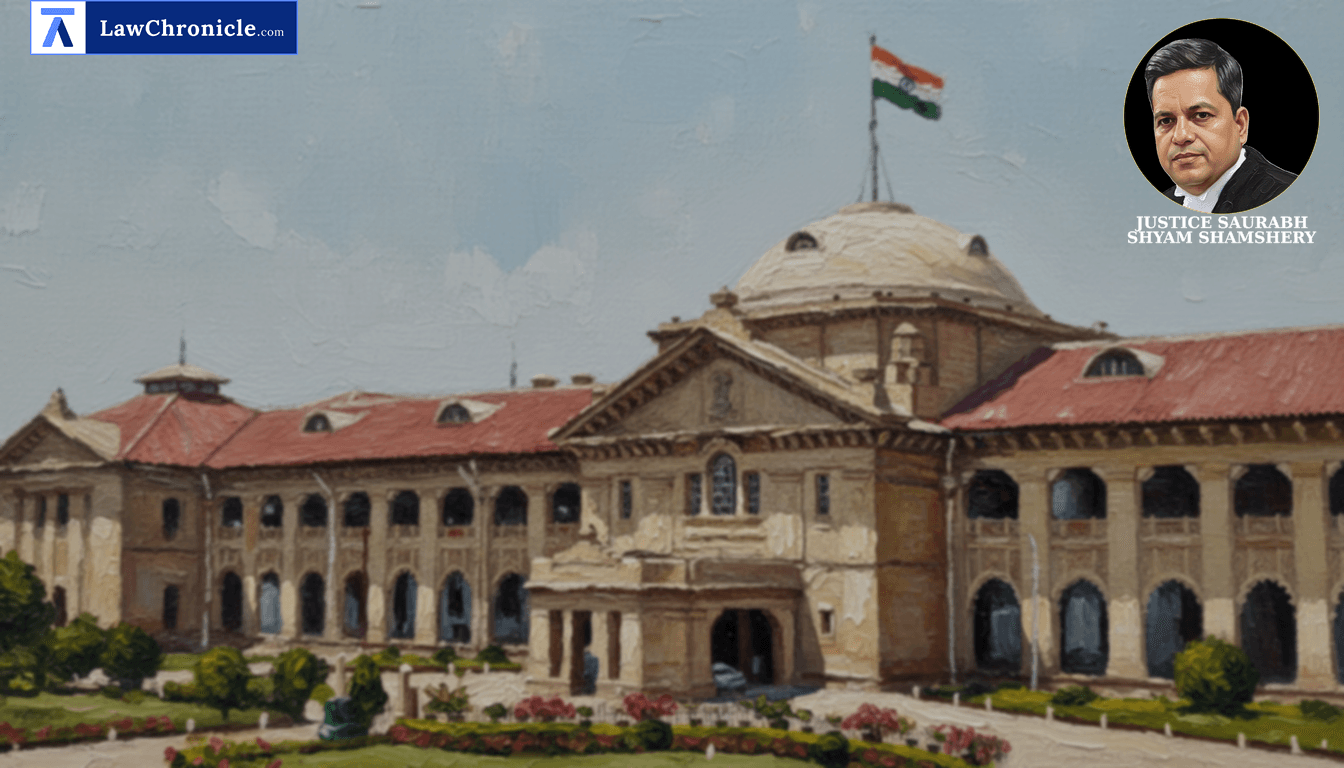
The Allahabad High Court has set aside a 'Censure' penalty and restrictive orders imposed on an Associate Professor accused of sexual harassment, citing a fundamental failure in following the mandatory inquiry procedure prescribed under the Sexual Harassment of Women at Workplace (Prevention, Prohibition and Redressal) Act, 2013. While acknowledging the gravity of allegations made by multiple female students, the Court emphasized that a Special Act's provisions must be strictly adhered to in both letter and spirit to maintain the sanctity of the inquiry process.
In a decision delivered by Justice Saurabh Shyam Shamshery, the Court observed that the Internal Complaints Committee (ICC) of the Harish Chandra Research Institute failed to record victim statements or provide an opportunity for cross-examination, thereby rendering the final report and subsequent punishment legally unsustainable.
Defective Inquiry Procedure and Violation of Natural Justice
The Court noted that the manner of inquiry as mandated under Section 11 of the Sexual Harassment of Women at Workplace (Prevention, Prohibition and Redressal) Act, 2013 read with Rule 7 of the Sexual Harassment of Women at Workplace (Prevention, Prohibition and Redressal) Rules, 2013 was not followed. Specifically, the Court highlighted that the ICC's report lacked references to whether complainant statements were recorded or if the petitioner was given a chance for an oral hearing.
The Court, in its reasoning, observed: "The Court finds that manner of inquiry... was not followed by ICC. Though petitioner was provided copy of complaints but certain details were not provided... there is no reference in ICC report, whether statements of complainants were recorded before Committee or not and if statements were recorded, whether a copy of same was provided to petitioner or not. There is no reference, whether petitioner was asked to cross-examine the complainants or was provided any opportunity of oral hearing... therefore, the Court finds that procedure adopted by ICC was defective."
The Dilemma of Limitation and Serious Allegations
A significant part of the argument revolved around Section 9 of the Sexual Harassment of Women at Workplace (Prevention, Prohibition and Redressal) Act, 2013, which prescribes a three-month limitation period for filing complaints. The petitioner argued that the complaints, spanning 2013-2016, were belated. However, the Court took note of the harrowing nature of the allegations, which included unwelcome physical contact and late-night calls.
Referring to the precedent in X vs. Nirmal Kanti Chakrabarti and others, the Court acknowledged that while limitation is a mandatory requirement, the object of the Sexual Harassment of Women at Workplace (Prevention, Prohibition and Redressal) Act, 2013 as inspired by the landmark Vishaka and others vs. State of Rajasthan and others ( "1997(6) SCC 241": 1997 CaseBase(SC) 1720) is to provide protection and redressal. It held that complaints involving vulnerable students against their superiors cannot always be rejected at the threshold on technical grounds of delay.
Background:
The petitioner, an Associate Professor of Astrophysics at the Harish Chandra Research Institute (HCRI), challenged an order dated July 9, 2017. The HCRI Governing Council had imposed a penalty of 'Censure' and barred him from supervising female students after the ICC found him guilty of serial harassment based on ten complaints. The petitioner contended that the ICC ignored the statutory limitation period and denied him a fair trial by not allowing cross-examination. The Court ultimately found the procedure defective but refused to quash the complaints entirely, instead remitting the matter to the ICC for a reasoned decision on the limitation and a fresh inquiry if deemed maintainable.
Case Details:
Case No.: WRIT - A No. - 12736 of 2018
Case Title: Dr. Tapas Kumar Das vs. Harish Chandra Research Institute And 3 Others
Appearances:
For the Petitioner(s): Sri Ritzu Ghoshal, Senior Advocate; Sri Sayantan Chatterjee, Sri Anirban Ghosh, Ms. Vishakha Pandey, Badal Chatterjee, Chandan Sharma, Roshni Shukla, Sri P.N. Saksena, Sr. Advocate, Vishakha Pande, Advocates
For the Respondent(s): Sri Rahul Agarwal, Senior Advocate; Ms. Akashi Agarwal, Udai Chandani, Advocates
Source: 2026 CaseBase(ALL) 171
 Breaking News